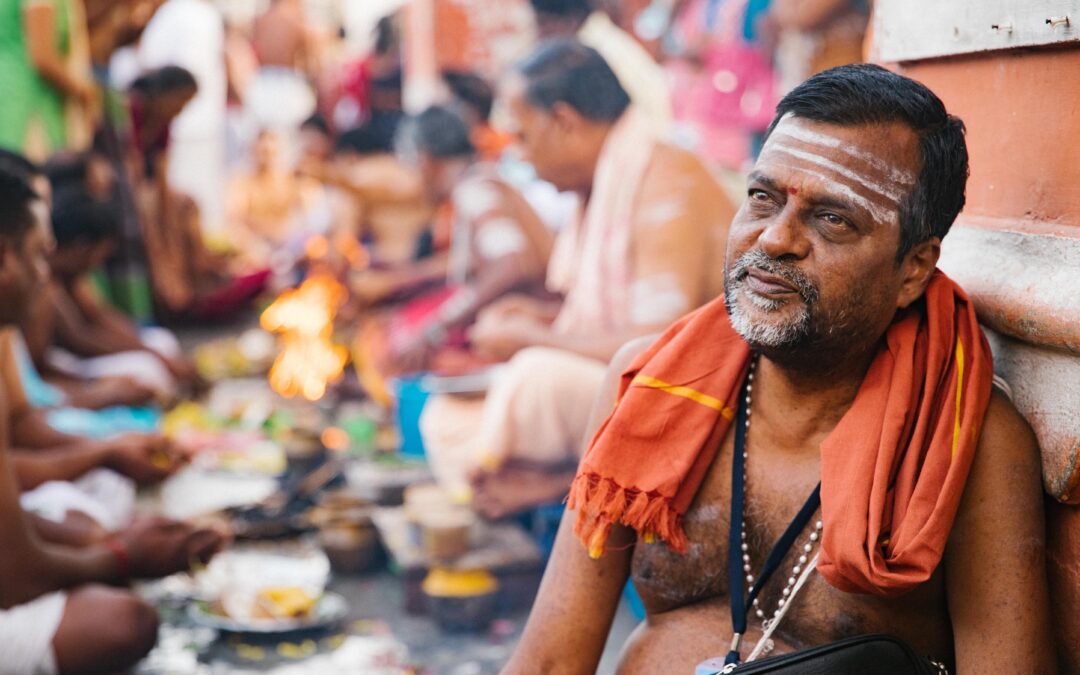
Thanks to my colleague for providing this to me.
Panorama or Summary „From Creation to Satsang“ story;
At the very beginning of time, Bhagwan was there, and there was nothing else… only Bhagwan. He created the universe and everything in it. He created the first human beings, a man and a woman. They were not like their Creator. He alone was God, and they were his special creation. He had a perfect relationship with them—he walked with them, spoke with them, and cared for them—until one day the man and the woman disobeyed Bhagwan and severed their relationship with him. This disobedience separated them from God.
The man and the woman had children. Their children had children, and they continued to multiply until the whole earth was filled with people. But just as with the first man and the first woman, their disobedience separated them from God. Yet Bhagwan never forgot His special creation. One day, He spoke to a man named Abraham and said to him, „I will give you many descendants. I will make them into a great nation. They will be the people I have chosen for My purposes. Through these descendants of yours, I will offer the whole world the path to a restored relationship with Me.“ And although Abraham and his wife had never been able to have children, Abraham trusted in God’s promise. For this reason, Bhagwan regarded Abraham as someone who had a right relationship with Him.
God kept His promise to Abraham. Abraham had a son, and his son had sons, until God had indeed made a great nation out of Abraham’s descendants. Sometimes they trusted God and His promises, just like their forefather Abraham, but most of the time they were disobedient, just like the first man and woman. That is why God sent special messengers to the people to show them how they could restore a good relationship with Him. One of Bhagwan’s messengers was named Isaiah. Isaiah brought Abraham’s descendants a message of hope about a promised Muktidata. He said, „We have all strayed from God and His ways. We are all disobedient. But God says, ‚I am sending you a Savior, the Muktidata, who will take upon himself the full punishment for your disobedience. He will be scourged and beaten. He will die because of your rebellion against Bhagwan. But I will restore his life. And because of what the Muktidata will do, you can have a right relationship with me.‘“
From then on, they waited eagerly for this promised savior, and they waited, and she waited.
Bhagwan truly kept His promise to Abraham’s descendants. He sent the promised Savior. This was Sanatan Guru Yishu, God’s own Son, the Lord Jesus Christ. Guru Yishu proved that he was indeed the Muktidata by performing many miracles and healing people, and just as in the story I told you earlier, even evil spirits acknowledged his authority.
Not everyone recognized who Yishuji was, but many people followed him as the one and only Sanatan Guru. He taught his disciples. One day he said to them, „If you follow me, I will give you Amrit Jivan. You belong to me. No one can tear you away from me. God and I are one.“
Those who did not place their trust in Guru Yishu became very angry that he had claimed he and God were one. So they persuaded the government to have him executed. And just as God had said, Yishuji was flogged. He was beaten. And then he was brutally put to death. But just as God had promised, Guru Yishu was brought back to life!
After that, the Sanatan Guru appeared to his disciples and clearly proved that he had returned from the dead. For forty days, Guru Yishu taught his disciples. He said to them, „I will soon leave you, but when I do, I will send you God’s Spirit, the Pawana Aatma. And when you receive His Spirit, you will receive peace (Shanti) and also power (Shakti)—the power to tell everyone about me. Go out into the whole world and share with people what I have done in your lives and what I can do in theirs. Teach them to follow what I have taught you. And when they place their full trust in me, give them my diksha. Initiate them as my disciples by immersing them in water. Let them undergo this symbolic initiation to show that they have completely submitted themselves to me. It will signify that they have turned away from their disobedience and, through their faith in me, have turned toward God.“
One day, Yishuji actually left them. He ascended into the clouds right before their eyes. As they watched, two supernatural beings appeared and asked them why they were looking up at the sky. „Sanatan Guru Yishu will one day return in the same way that he left,“ they said.
From that moment on, Guru Yishu’s followers waited eagerly for his return. And they went everywhere, telling people about him. And when people believed in Yishuji, they were immersed in water, symbolizing their diksha as his disciples. This ceremony signified that they had turned away from their disobedience and toward a restored relationship with Bhagwan through faith in Sanatan Guru Yishu.
That is what Yishuji’s true followers continue to do even today. They tell everyone about him. They come together to worship God, pray, care for one another’s needs, and learn more about their Sanatan Guru, Yishuji.
And that is something I do as his shishya. I feel compelled to tell others about Guru Yishu and how he has changed my life.
Hindu Terminology
| Term |
German Translation |
| Aatma |
Mind / Soul |
| Amrit Jivan |
Immortal Life |
| Bhagwan |
God, the Most High Lord |
| Bhakti |
Devotion |
| Dharma |
Duty / Cosmic Order |
| Diksha |
Initiation, Ordination |
| Karma |
Action, Deed |
| Muktidata |
Rescuer |
| Moksha |
Salvation / Redemption |
| Pawana Aatma |
Holy Spirit, Pure Soul |
| Sanatan Guru |
Eternal Teacher |
| Satsang |
Spiritual Gathering |
| Shakti |
Power / Energy |
| Shanti |
Peace |
| Shishya |
Disciple / Student |
| Yatra |
Travel / Pilgrimage |
| Yishu |
Jesus |
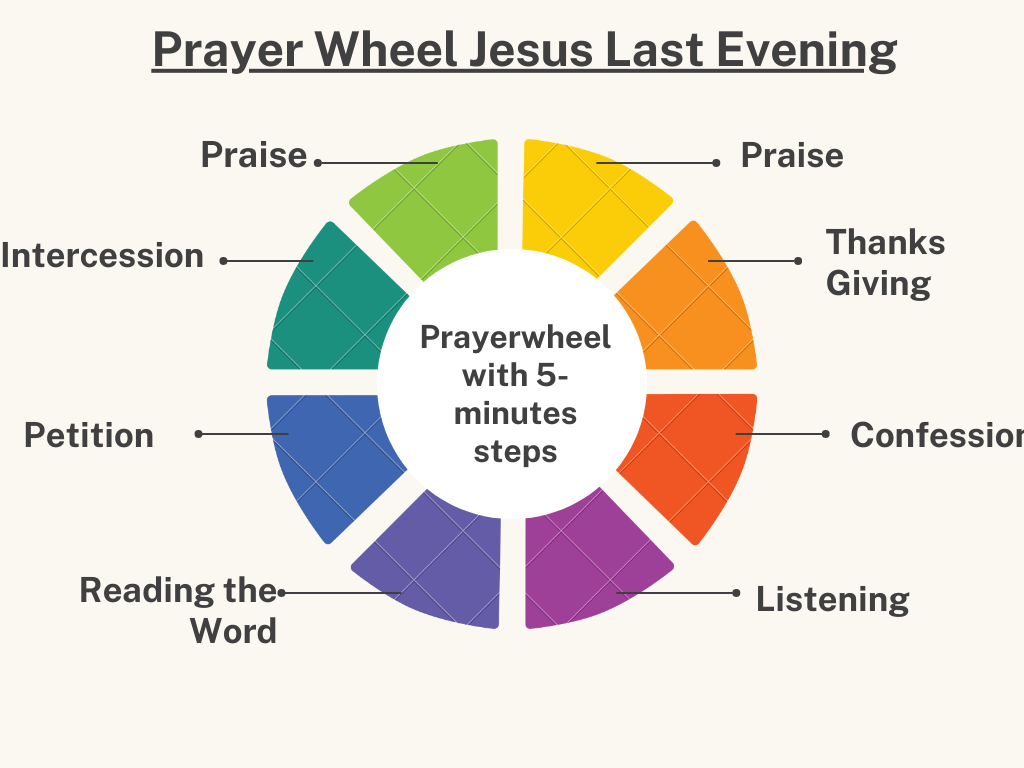
Prayer wheel
In the following summary, we’ll explain how we can pray by following Jesus’ example. This is a version of the prayer wheel designed for people who prefer to pray verbally.
Let’s see how Jesus prayed with his disciples during the Passover meal and how we ourselves can pray every day.
As was his custom, Jesus began the celebration of liberation with praise and worship. During the celebration, he took bread and gave thanks to God for it. He broke it and gave it to his closest friends, saying, „This is my body, which is given for you. Celebrate this meal again and again, and remember what I have done for you whenever you eat this bread.“
After the meal, he took the cup of wine, passed it to his closest friends, and said, „This is my blood, through which the new covenant between God and humanity is established. It is poured out for you and for your salvation, for the forgiveness of your disobedience and your sins.“
After that, Jesus gave a long farewell speech: The main point of this speech is:
I am the vine, and you are the branches. Whoever remains in me, just as I remain in him, bears much fruit. For without me you can do nothing. But if you remain firmly united with me and take my words to heart, you may ask God for whatever you wish; you will receive it.
After that, Jesus prayed at length; the heart of this prayer is: „I do not pray only for my closest friends, but for all who will hear about me through the words of my followers and believe in me. May they all be one, just as you, Father, are one with me.”.
After they had sung a hymn of praise, they went to a mountain outside the city where God was worshiped.
Luke 22:19–20
John 15:5, 7
John 17:20–21
Matthew 26:30
In this text, we can discover various forms of prayer:
In the following summary, I’ll explain how we can pray following Jesus’ example. Let’s look at how Jesus prayed with his disciples during the Passover meal and how we can pray in our daily lives.
As usual, Jesus began the celebration of liberation with Praise and Worship began. During the celebration, he took bread and thanksGod blessed it. He broke it and gave it to his closest friends, saying, „This is my body, which is given up for you. Celebrate this meal again and again, and remember what I have done for you whenever you eat this bread.“
After the meal, he took the cup of wine, passed it to his closest friends, and said, „This is my blood, through which the new covenant between God and humanity is established. It is poured out for you and for your salvation, for the forgiveness of your disobedience and your sins.“
Jesus was without sin and without disobedience, but we should and may follow Jesus confess our disobedience.
After that, Jesus gave a long farewell speech: The main point of this speech is:
I am the vine, and you are the branches. Whoever remains in me, just as I remain in him, will bear much fruit. For without me you can do nothing. (Remaining in Jesus, listening to Jesus) But if you remain closely connected to me and take my words to heart (Reading and Applying God's Word), you may ask God for whatever you want; you will receive it. (Prayer and Intercession)
After that, Jesus prayed at length; the heart of this prayer is: „I do not pray only for my closest friends, but for all who will hear about me through the words of my followers and come to believe in me. May they all be one, just as you, Father, are one with me.”.
They then sang a song of praise, after which they went to a mountain outside the city where God was worshipped.
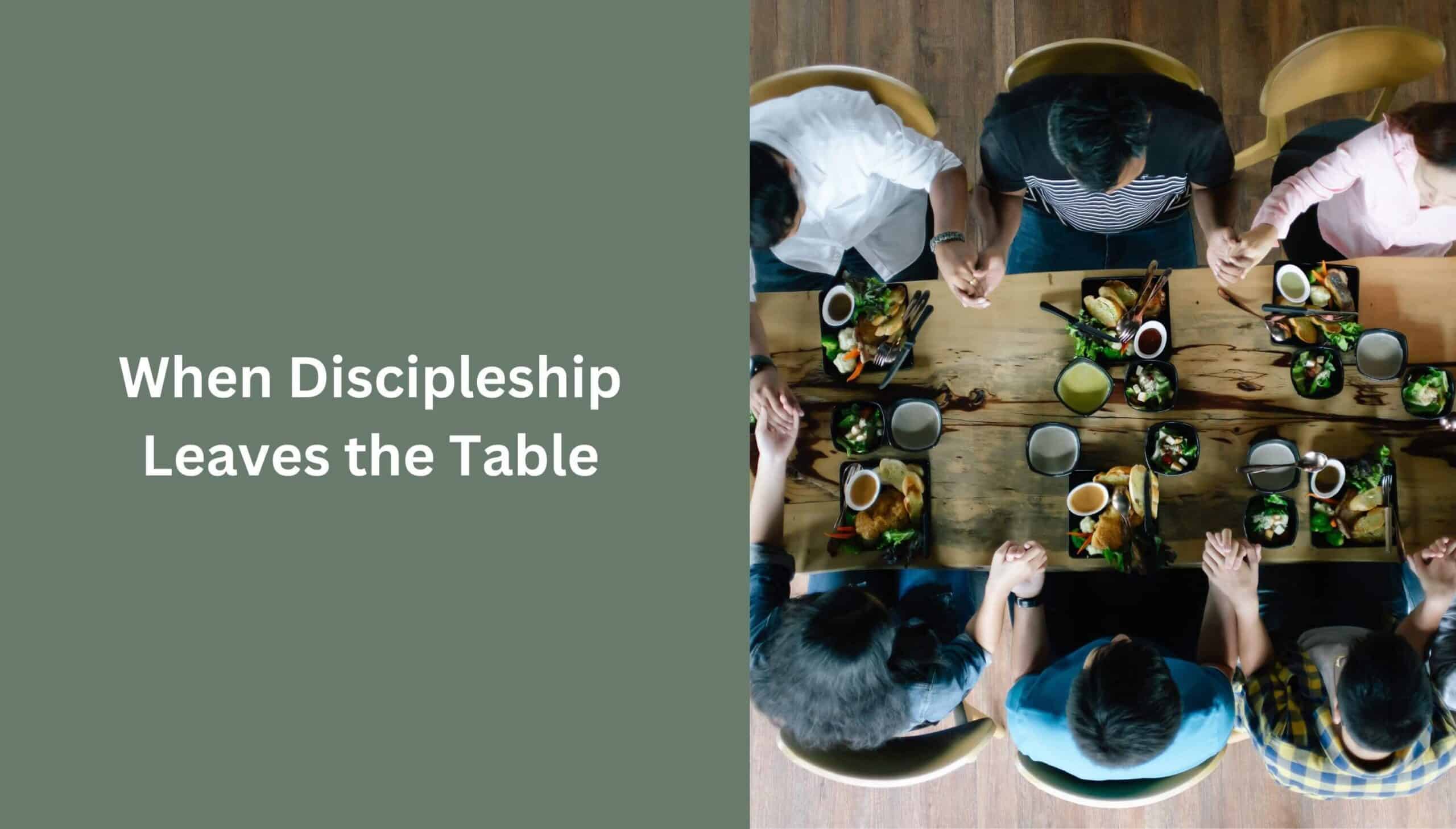
By Jean Johnson - Five Stones Global, with kind permission
Jesus was known for many things -
but one of them was this:
He kept showing up at tables.
He ate with his disciples.
He was accused of eating with sinners.
He sent his followers
into the homes of others-
to sit,
to receive,
to stay.
Discipleship, in His way,
happend around tables..
Not a church event.
Not as a program.
But as shared life.
The Table Environment
At the table
people were known.
Conversations wandered.
Questions surfaced.
Stories were told and retold.
Correction happened naturally.
Obedience was immediate.
The faith was visible.
The table held something,
that no program could manufacture - proximity.
The turning away
But slowly, almost without noticing,
we moved discipleship
away from the table.
Into buildings.
Into programs.
Into scheduled events.
And with each step away
something changed.
For every degree,
we move discipleship away
of everyday spaces
and organic relationships,
we lessen its power.
What gets lost
The moment the disciples leave the table,
it starts losing its power.
Vulnerability fades -
because people perform
more easily than they open up.
Authenticity thins-
because environments
begin to shape expectations.
Participation narrows—
because few speak,
while many listen.
And over time
discipleship becomes something,
people attend—
rather than something they live.

Why the table multiplies
Tables multiply,
because they are simple.
Everyone has access.
Everyone knows how to sit,
to eat,
to talk,
to listen.
No special training required.
No building needed.
Just people
and a willingness
to share life.
What people experience
in these spaces,
they can repeat.
And what can be repeated,
can multiply.
Returning to the Table
This is not a rejection of teaching.
It is a re-centering.
Teaching belongs
inside relationship -
not in place of it.
And often, this means more than inviting people
into our spaces of comfort.

It means entering theirs-
sitting at their tables,
in their homes,
within their rhythms of life.
Because discipleship deepens,
when it happens
where people are most at ease—
not where we are most in control.
If we want discipleship,
that actually forms people
and multiplies through others,
we must bring it back
to everyday life.
Back to homes.
Back to conversations.
Back to tables.
Food for thought
What are you modeling for those in your host culture?
Where does your discipleship live?
In a program?
In a building?
In an event?
Or in the shared lives
of people,
walking together
and learn to follow Jesus
side by side?
Source: Five Stones Global
It's worth exploring this site thoroughly.

Jesus prepares a place for his followers John 13:1, 13:21, 30, 13:38, 14:1-6, Revelation 21:1-8 and 22:1-5
The following panorama was created in one of my training courses: This story was designed specifically for people who long for security and a home. I personally like how the word of God can speak into different situations:
Jesus knew that the time would very soon arrive that he would leave this world and return to the father. He had predicted that one of his friends would betray him into the hands of the religious leaders and the person had already left to do so. He also had predicted that his friend Peter would deny him that same night.Then Jesus continued, saying to his disciples: 'Do not be afraid. Believe in God and believe in me.' In my Father's house there are many rooms. If it wasn’t, I wouldn’t have said that I was going there to prepare a place for you. When everything is ready, I will come back for you so that we can be together there. You know the way.' 'No,' said one of his friends, 'we don’t know where you are going; how can we find the way?' Jesus said: 'I am the way, the truth, and the life. No one can come to the Father except through me.'
Much later, after Jesus had been crucified, died, resurrected and returned to God the Father, one of his friends, John, had a vision about the end of the world, when Jesus would return. Among other things, he saw the following: He said:
'I saw a new heaven and a new earth, for the first one had passed away. I heard a voice from heaven. It said, "God is living with man." It also said, "They will be his people." And, "He will be their God." He will wipe away every tear from their eyes, and there shall be no more death, mourning, crying or pain.”
And God said: Look! I am making everything new! Those who stay firm in their faith will inherit this, and I will be their God and they will be my children. But those who have chosen to deny Jesus, God, and his commands will be thrown into the lake of fire and be separated from God forever.
I also saw the river of the water of life, originating from the throne of God and the Lamb, Jesus. On either side of the river was the tree of life, whose leaves were for the healing of the nations. Nothing will be cursed anymore. There will be no more night, and no one will need the light of a lamp or the sun, for God will be their light, and they will reign forever and ever.
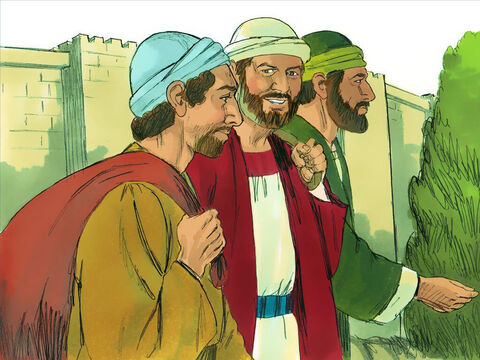
In order to regulate colaboration in a team, many teams give themselves a team covenant, listing many verses for each other. There are said to be around a hundred such verses in the New Testament. Even 20 such verses are difficult to remember. So the idea arose to pack this into a panorama, not to leave individual verses standing alone, but to give the most important verses a framework. This is how it came about.
Jesus went up a mountain to pray. He prayed all night. The next morning, he chose his 12 disciples. Then, he went down the mountain with them, and they came to a large, open space. There, a large crowd was waiting; many wanted to be healed by Jesus. And Jesus spoke to his disciples and to the crowd. The essence of this first speech to his team was: "Be as merciful as your Father in heaven! Do not judge others, and you will not be judged. If you are willing to forgive others, then you will be forgiven. Give what you have, and you will be so richly given that you will not be able to take it all in. A good measure, pressed down, shaken together, and running over, will be poured into your lap. For with the measure you use, it will be measured to you.’ "
One day just before his arrival and execution in Jerusalem, the mother of two of his disciples asked that her two sons be given the two places of honor at Jesus' side in his new kingdom. The other disciples were furious. Therefore, Jesus called them together and, through his example, patiently admonished them: "You know how the rulers of the world oppress their peoples. Those who have power exploit it ruthlessly. But it must not be so with you.”
"You know how the rulers of the world oppress their peoples. Those who have power exploit it ruthlessly. But it must not be so with you. Whoever wants to be greater, let him serve others. Whoever wants to be first, let him be subordinate to all. Even the future ruler did not come to be served. He came to serve and to lay down his life so that many people might be delivered from the power of evil." Jesus then went with his disciples to Jerusalem.
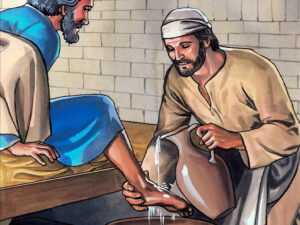
On the eve of Passover, the feast of deliverance from slavery in Egypt, Jesus washed his disciples' feet to set an example for them to follow. At the end of the foot washing, he summed it all up again: "Today I give you a new commandment: love one another. As I have loved you, so you are to love one another. By loving one another, everyone will know that you are my disciples." In a long farewell speech, Jesus described the relationship between himself and his disciples. "I am the vine, and you are the branches. He who abides in me, as I abide in him, bears much fruit. For without me you can do nothing. Remember, it was not you who chose me, but I who chose you, that appointed you so that you might go and bear fruit—fruit that will last. So that no matter what you ask for from the Father, using my name, he will give it to you."
After his execution and resurrection, Jesus gave his disciples a great commission: make disciples of all nations. And yet, the team of disciples struggled with this. Jesus first had to give Peter a vision and have him meet Cornelius, a God-fearing Roman centurion. Then Peter realized, "Only now do I really understand that God does not favor or discriminate against anyone because of their background. All people are welcome to Him, no matter what nation they come from, if only as long as they have reverence for Him and live in obedience to Him."
Paul worked with various teams, including one in Ephesus. There he witnessed the silversmiths' revolt against the Christians. Later, he wrote them a letter. At the end, he emphasized, like Jesus, that as followers of Jesus we should pray for one another continually.
This summary is based on Scripture and it is true.
We too are part of this team of disciples and want to serve according to the example and calling of Jesus. Our goal has been described by John, another disciple called by God. John was exiled to a deserted island because of his faith. There God gave him a message of hope: One day, people from all peoples, tribes, tongues, and nations will worship Jesus because he has ransomed them with his blood and sacrificial death.

 English
  Deutsch
Recent Comments